Showing posts with label seeming and being. Show all posts

Monday, April 2, 2012

Being and the Self: The Example of English Romanticism

(this is a multimedia podcast I made a few years ago with GarageBand, and serves not only as background for our discussion of Romantic poetry, but also as a model of a multimedia podcast project)

We'll read some poems closely on Tuesday

"I wandered lonely as a cloud," Wordsworth, p. 43
"Mutability," Wordsworth, p. 57
"Kubla Khan," Coleridge, p. 105


Friday, March 2, 2012

Hamlet: "Seems, madam! nay it is; I know not 'seems.'"


Methinks Hamlet does know "seems," and very well.  What about being?

There is so much in this play--revenge, sanity and insanity, the genre of tragedy, family relationships, surveillance and privacy, doing and thinking, corruption and decay- but we are going to focus on how Shakespeare's play sheds light on our enduring questions about the complex relationships between being and seeming--in everyday life, in performance, and as we consider the contemporary film interpretations of Hamlet, in media representations.


HAMLET

Seems, madam! nay it is; I know not 'seems.'
'Tis not alone my inky cloak, good mother,
Nor customary suits of solemn black,
Nor windy suspiration of forced breath,
No, nor the fruitful river in the eye,
Nor the dejected 'havior of the visage,
Together with all forms, moods, shapes of grief,
That can denote me truly: these indeed seem,
For they are actions that a man might play:
But I have that within which passeth show;
These but the trappings and the suits of woe. Act 1, Scene 2


Shakespeare, and the directors of the film interpretations, contrast Laertes with Hamlet.  We pick up at around the 3:20 minute mark, in this clip from the Royal Shakespeare Company film:


and at 4:20 in the Branagh film


HAMLET

O, that this too too solid flesh would melt
Thaw and resolve itself into a dew!
Or that the Everlasting had not fix'd
His canon 'gainst self-slaughter! O God! God!
How weary, stale, flat and unprofitable,
Seem to me all the uses of this world!
Fie on't! ah fie! 'tis an unweeded garden,
That grows to seed; things rank and gross in nature
Possess it merely. That it should come to this!
But two months dead: nay, not so much, not two:
So excellent a king; that was, to this,
Hyperion to a satyr; so loving to my mother
That he might not beteem the winds of heaven
Visit her face too roughly. Heaven and earth!
Must I remember? why, she would hang on him,
As if increase of appetite had grown
By what it fed on: and yet, within a month--
Let me not think on't--Frailty, thy name is woman!--
A little month, or ere those shoes were old
With which she follow'd my poor father's body,
Like Niobe, all tears:--why she, even she--
O, God! a beast, that wants discourse of reason,
Would have mourn'd longer--married with my uncle,
My father's brother, but no more like my father
Than I to Hercules: within a month:
Ere yet the salt of most unrighteous tears
Had left the flushing in her galled eyes,
She married. O, most wicked speed, to post
With such dexterity to incestuous sheets!
It is not nor it cannot come to good:
But break, my heart; for I must hold my tongue.


Laurence Olivier's 1948 performance of Hamlet's soliloquy in Act 1, scene 2


Ethan Hawke's 2000 performance:

In this clip, Patrick Stewart discusses setting Shakespeare in a contemporary or historical context, acting for stage and film, and some issues about performance that are central to our discussions.


Wednesday, February 29, 2012

Don Quixote, Seeming, & Being

We've been discussing how Don Quixote--the character--manifests with different facets highlighted in different versions: Cervantes's 1605 and 1615 novel, Nureyev's ballet film Don Quixote, the musical Man of La Mancha, in the levels of irony in the documentary Lost in La Mancha about Terry Gilliam's quixotic failed quest to make his film of Don Quixote, and in the visualizations in the graphic novel adaptation.

We began with some excerpts from a lecture from Professor Roberto González EchevarrĂ­a's Yale University course on Don Quixote (so we know how to say Quixote!) and that gave us a strong foundation in a literary approach to the novel. Our interest, however, is how Don Quixote becomes an romanticized hero whose preference--or insistence--on internal reality over external reality is something to be valued not (only) mocked.   For Quixote, in the ballet, in Gilliam's vision, in the popular imagination, illusion is his reality; he cannot differentiate between seeming and being. The 20th-century texts question why it is necessary to make that distinction, and, in a very different way than Machiavelli, who makes the case for seeming over being in The Prince.  Let's talk about those differences.

Momchil Mladenov as Don Quixote and Sonia Rodriguez as
 Dulcinea in the Suzanne Farrell Ballet's production at the Kennedy Center.

INTERNAL & EXTERNAL REALITY: The twentieth-century texts dramatize and visualize Don Quixote's internal reality, and as they do that so we can see it, we are more interested in and open to his perspective.  Visually, dramatically, and narratively, they get more equal weight than in the Cervantes novel.  When we see Quixote's imagined Dulcinea dancing in the ballet, she exists, as opposed to the pure fantasy of the text Dulcinea, or the taking on of the role of Dulcinea by Aldonza in Man of La Mancha.  The modern, post-modern interest in Don Quixote stems from our interest in subjectivity, in how individuals perceive the world (and this is where the readings by Maurice Merleau-Ponty come in).

Realizing Don Quixote's internal reality is what Terry Gilliam wanted to do.  As we watch the documentary, we can see how he could see, in his mind's eye, how he wanted his film to show the giants, for example.  But he could not make that internal vision into an external reality of a film, and so he, like Don Quixote, experiences a gap between interior and exterior realities.  This is the non-insane,
modern version of Quixote, and it is the artist's eternal difficulty, that chasm between what we hear or see or imagine and what can be actualized in performance or art so it can be shared.

PERFORMANCE: We have two central ideas about performance for this unit: the performance of self in everyday life, and the idea that performance is always for someone, so there is a sense of doubling.  These are two themes we will see in Hamlet.  An interesting question is whether Don Quixote is performing?  He takes on the role of "knight" and speaks and acts, to his mind, accordingly, despite external reality, but is there a doubling?  Again, this is a question we'll encounter again in Hamlet.


Finally, let's consider one of the famous quotations from Don Quixote in the context of our overall course themes and areas of inquiry: “I know who I am, and who I may be, if I choose.”


Monday, February 6, 2012

The Case for Seeming Over Being: Machiavelli


In contrast to Plato's discourse on the Republic and belief in the Forms, Machiavelli writes:
for many have pictured republics and principalities which in fact have never been known or seen, because how one lives is so far distant from how one ought to live, that he who neglects what is done for what ought to be done, sooner effects his ruin than his preservation . . . (chapter 15).

Machiavelli's view of goodness in context: "A man who wishes to make a profession of goodness in everything must necessarily come to grief among so many who are not good" (63).

Ch. 18: Machiavelli uses the mythic example of Chiron, the centaur, and the animals of the lion and the fox to illustrate some of the ways a prince must act.

Ultimately, and most importantly for our focus, he concludes:

"It is not, therefore, necessary for a prince to have all the above-named qualities, but it is very necessary to seem to have them" (73).

Ch. 23: Echoing Cicero's warning against flatterers, Machiavelli picks up the question, really, of friendship, and to whom a prince should listen to for counsel.


Tuesday, January 31, 2012

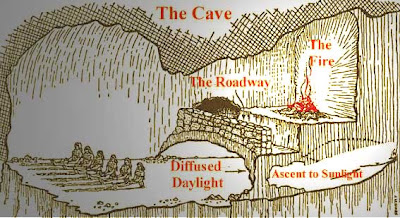
Plato's Allegory of the Cave: Video Resources for the Case for Being Over Seeming

Plato, to make an understatement, comes down on the side of being over seeming. But what can be known, and what is real in this world were questions he explored. One way he approached these ideas was through the story of the prisoners in the cave, and the one who is freed, dragged out into the sunlight and the physical world, and then returns to the cave to try to tell the others that what they think is the world is actually illusion, seeming, not being.


Who was Plato?


The Allegory of the Cave, from Book VII (7) of The Republic


Excellent lecture on The Allegory of the Cave (and more) with creative and animated lecture whiteboard, like an animated "For Beginners" kind of comic.

by Tim Wilson, http://www.zontulfilms.com/

Claymation film of the Allegory of the Cave--with lovely voice over narration reading the text

Some of this sound familiar from other things you've read or seen in movies?

Tuesday, January 24, 2012

to be, rather than to seem

Esse quam videri: to be, rather than to seem to be

Where does this come from? Cicero!

Cicero (106-43 BCE)


M. Tullius Cicero, Laelius on friendship
William Armistead Falconer, Ed.


[97] 26. Now, if on the stage, I mean on the platform, where there is the greatest opportunity for deception and disguise, truth yet prevails, provided it is made plain and brought into the light of day, what ought to be the case with friendship which is wholly weighed in the scales of truth? For in friendship, unless, as the saying is, you behold and show an open heart, you can have no loyalty or certainty and not even the satisfaction of loving and of being loved, since you do not know what true love is. And yet this flattery of which I spoke, however deadly it may be, can harm no one except him who receives and delights in it. It follows that the man who lends the readiest ear to flatterers is the one who is most given to self-flattery and is most satisfied with himself.

[98] I grant that Virtue loves herself; for she best knows herself and realizes how lovable she is; but [p. 205] it is not virtue I am talking about but a reputation for virtue. For many wish not so much to be, as to seem to be, endowed with real virtue. Such men delight in flattery, and when a complimentary speech is fashioned to suit their fancy they think the empty phrase is proof of their own merits. There is nothing, therefore, in a friendship in which one of the parties to it does not wish to hear the truth and the other is ready to lie. Nor should we see any humour in the fawning parasites in comedies if there were no braggart soldiers.1
In truth did Thais send me many thanks?
It would have been enough to answer, “Many.” “Millions of them,” said the parasite. The flatterer always magnifies that which the one for whose gratification he speaks wishes to be large.

1 Laelius has in mind Thraso in the Eunuch of Terence, from which (ii. 1. 1) the following line is taken, and Pyrgopolinices, the braggart soldier in Plautus' Miles Gloriosus. The disgust Laelius feels at the fawning of the parasite is relieved by the humour of the soldier.

[99] Wherefore, although that sort of hollow flattery influences those who court and make a bid for it, yet even stronger and steadier men should be warned to be on their guard lest they be taken in by flattery of the crafty kind.

No one, to be sure, unless he is an utter fool, fails to detect the open flatterer, but we must exercise a watchful care against the deep and crafty one lest he steal upon us unawares. For he is very hard to recognize, since he often fawns even by opposing, and flatters and cajoles by pretending to quarrel, until at last he gives in, allowing himself to be overcome so that his dupe may appear to have seen further into the matter than himself. And yet, is there anything more discreditable than to be made a dupe? If not, then we should be all the more on our guard that it does not happen to us to have to confess: [p. 207]

To-day, of all old fools that play the comic parts,
You've wheedled me the most and made your greatest dupe.

Lines from the Epiclerus by Caecilius Statius.1