Showing posts with label "What Is Being?". Show all posts

Monday, February 13, 2012

Performance: Goffman and Abramovic

What is performance?

Erving Goffman was interested in the presentation of self in everyday life, how theatrical performance can be a metaphor of the role-playing people do all the time. He defines performance as "all the activity of an individual which occurs during a period marked by his continuous presence before a particular set of observers and which has some influence on the observers" (The Presentation of Self in Everyday Life, 22).

Richard Bauman: the sense of an action carried out for someone, even if the audience is oneself
Performance necessitates a consciousness of doubleness, in which the execution of the action is compared mentally to an ideal.

In this way, we can say performance involves seeming and being.


"IS" and "AS" performance

Maria Abramovic retrospective at MoMA in 2010

Abramovic makes a distinction between performance and theater, saying that performance is "real" and theater is, essentially, artifice because it is rehearsed.


Abramovic on body art and Imponderabilia


Monday, February 6, 2012

The Case for Seeming Over Being: Machiavelli


In contrast to Plato's discourse on the Republic and belief in the Forms, Machiavelli writes:
for many have pictured republics and principalities which in fact have never been known or seen, because how one lives is so far distant from how one ought to live, that he who neglects what is done for what ought to be done, sooner effects his ruin than his preservation . . . (chapter 15).

Machiavelli's view of goodness in context: "A man who wishes to make a profession of goodness in everything must necessarily come to grief among so many who are not good" (63).

Ch. 18: Machiavelli uses the mythic example of Chiron, the centaur, and the animals of the lion and the fox to illustrate some of the ways a prince must act.

Ultimately, and most importantly for our focus, he concludes:

"It is not, therefore, necessary for a prince to have all the above-named qualities, but it is very necessary to seem to have them" (73).

Ch. 23: Echoing Cicero's warning against flatterers, Machiavelli picks up the question, really, of friendship, and to whom a prince should listen to for counsel.


Friday, February 3, 2012

The Cave, Internal Reality, & Subjectivity

Here are photos of the board from Thursday's seminar.

In case anyone needs to see the drawing of the camel again.


Tuesday, January 31, 2012

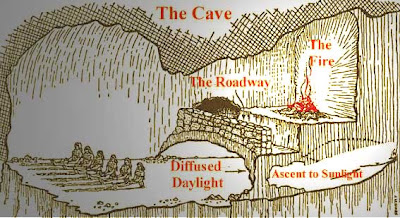
Plato's Allegory of the Cave: Video Resources for the Case for Being Over Seeming

Plato, to make an understatement, comes down on the side of being over seeming. But what can be known, and what is real in this world were questions he explored. One way he approached these ideas was through the story of the prisoners in the cave, and the one who is freed, dragged out into the sunlight and the physical world, and then returns to the cave to try to tell the others that what they think is the world is actually illusion, seeming, not being.


Who was Plato?


The Allegory of the Cave, from Book VII (7) of The Republic


Excellent lecture on The Allegory of the Cave (and more) with creative and animated lecture whiteboard, like an animated "For Beginners" kind of comic.

by Tim Wilson, http://www.zontulfilms.com/

Claymation film of the Allegory of the Cave--with lovely voice over narration reading the text

Some of this sound familiar from other things you've read or seen in movies?

Tuesday, January 24, 2012

to be, rather than to seem

Esse quam videri: to be, rather than to seem to be

Where does this come from? Cicero!

Cicero (106-43 BCE)


M. Tullius Cicero, Laelius on friendship
William Armistead Falconer, Ed.


[97] 26. Now, if on the stage, I mean on the platform, where there is the greatest opportunity for deception and disguise, truth yet prevails, provided it is made plain and brought into the light of day, what ought to be the case with friendship which is wholly weighed in the scales of truth? For in friendship, unless, as the saying is, you behold and show an open heart, you can have no loyalty or certainty and not even the satisfaction of loving and of being loved, since you do not know what true love is. And yet this flattery of which I spoke, however deadly it may be, can harm no one except him who receives and delights in it. It follows that the man who lends the readiest ear to flatterers is the one who is most given to self-flattery and is most satisfied with himself.

[98] I grant that Virtue loves herself; for she best knows herself and realizes how lovable she is; but [p. 205] it is not virtue I am talking about but a reputation for virtue. For many wish not so much to be, as to seem to be, endowed with real virtue. Such men delight in flattery, and when a complimentary speech is fashioned to suit their fancy they think the empty phrase is proof of their own merits. There is nothing, therefore, in a friendship in which one of the parties to it does not wish to hear the truth and the other is ready to lie. Nor should we see any humour in the fawning parasites in comedies if there were no braggart soldiers.1
In truth did Thais send me many thanks?
It would have been enough to answer, “Many.” “Millions of them,” said the parasite. The flatterer always magnifies that which the one for whose gratification he speaks wishes to be large.

1 Laelius has in mind Thraso in the Eunuch of Terence, from which (ii. 1. 1) the following line is taken, and Pyrgopolinices, the braggart soldier in Plautus' Miles Gloriosus. The disgust Laelius feels at the fawning of the parasite is relieved by the humour of the soldier.

[99] Wherefore, although that sort of hollow flattery influences those who court and make a bid for it, yet even stronger and steadier men should be warned to be on their guard lest they be taken in by flattery of the crafty kind.

No one, to be sure, unless he is an utter fool, fails to detect the open flatterer, but we must exercise a watchful care against the deep and crafty one lest he steal upon us unawares. For he is very hard to recognize, since he often fawns even by opposing, and flatters and cajoles by pretending to quarrel, until at last he gives in, allowing himself to be overcome so that his dupe may appear to have seen further into the matter than himself. And yet, is there anything more discreditable than to be made a dupe? If not, then we should be all the more on our guard that it does not happen to us to have to confess: [p. 207]

To-day, of all old fools that play the comic parts,
You've wheedled me the most and made your greatest dupe.

Lines from the Epiclerus by Caecilius Statius.1


Sunday, January 22, 2012

Welcome to LHUM P410: What Is Being?

Ever wonder, "what IS being?"

This course, "What Is Being?" is a special opportunity for Berklee students to explore an age-old question in multiple ways: through reading touchstone texts of philosophy, literature, psychology, and other disciplines; through exploring of how the subtleties of being and seeming play out in performance; and by considering what is being in contemporary culture. It is funded by a grant from the National Endowment of the Humanities, which pays for the students' books and tickets to plays, among other things. The class size is small (12) and the level of discussion is intense and interesting. We read into things. We look deeply. We keep asking questions and probably never really answer them fully. We'll read whole books and also parts of books, including a few choice sections from thinkers like Jean-Paul Sartre, Erving Goffman, Heidegger, and Jean Baudrillard. You can shape your multimedia projects about topics that interest you. If you think you are interested in taking this course this semester, keep reading.

Course Description

The motto of Berklee College of Music is Esse quam videri, a phrase from Cicero’s essay “On Friendship,” which translates as “to be, rather than to seem.” The course “What is Being?” gives you the opportunity to focus and reflect upon the differences between seeming and being, and think deeply about existence, self, and image. Organized around three interrelated themes: seeming vs. being; performance on stage and in everyday life; and the power of images and illusion in contemporary culture, the seminar requires students to consider realworld issues by exploring in depth the great works of philosophy, literature and psychology. The course includes the reading and discussion of Plato’s Republic, Machiavelli’s The Prince, Shakespeare’s Hamlet, and Cervantes’ Don Quixote. Funded by a National Endowment for the Humanities Enduring Questions grant, “What Is Being?” is a unique opportunity for serious seminar-style exploration of a foundational issue in human thought.

This course requires a commitment from the participants to:

attend class,

read the assigned material,

engage with the questions and ideas in multimedia and written assignments that will be turned in on time

attend at least one play (tickets provided by the NEH grant)

and participate fully in class discussion and activities.